


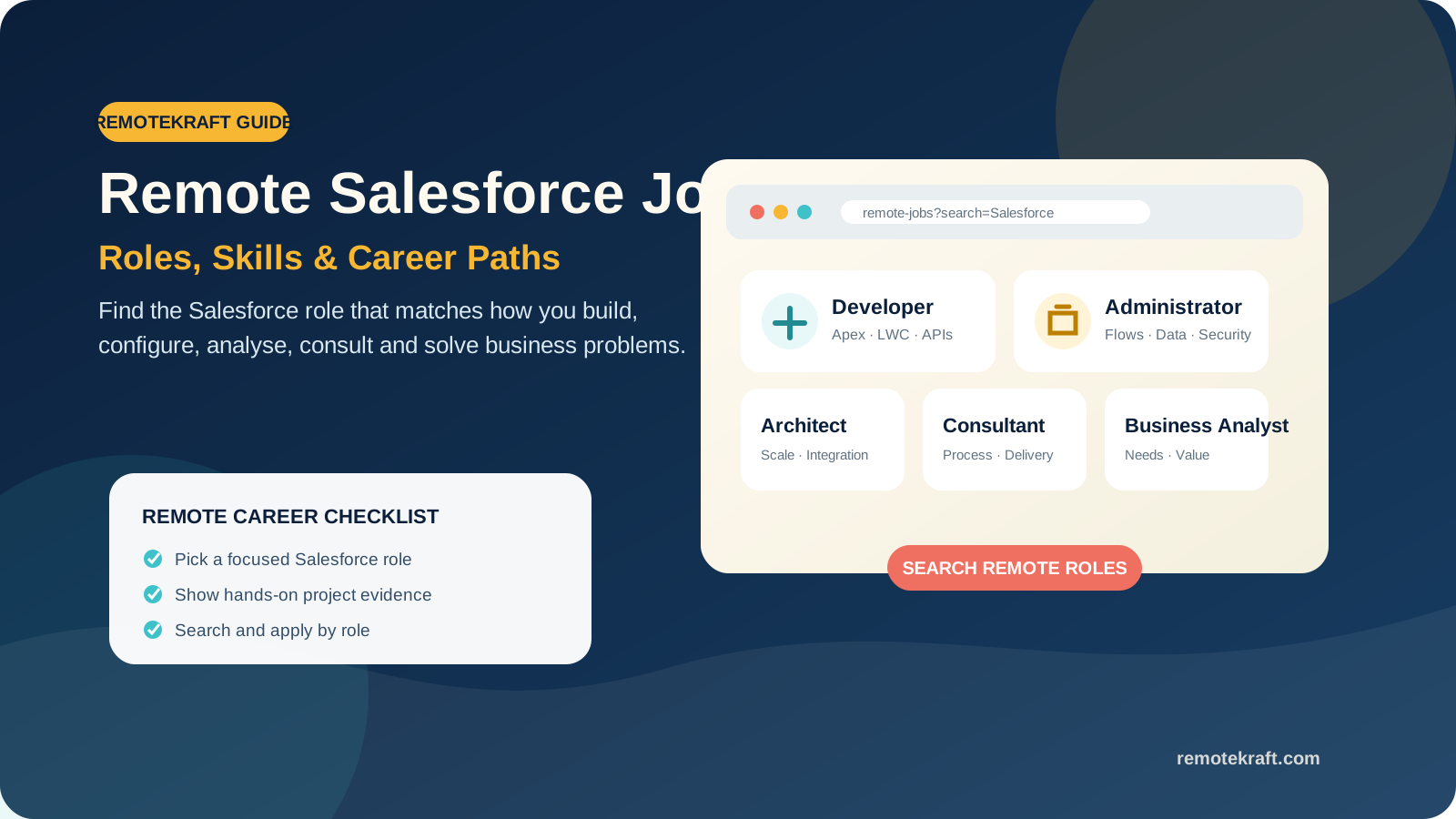
Remote Salesforce jobs cover much more than one job title. Companies use Salesforce for customer operations, automation, sales, service, marketing, analytics, integrations and increasingly AI-enabled workflows, which creates career paths for people who prefer coding, configuration, business analysis, consulting, testing or solution design.
If you are searching for a remote Salesforce career, the most useful first step is to choose a role that matches how you like to solve problems. A Salesforce Developer needs a different proof of work from a Salesforce Administrator, while an Architect or Consultant is usually expected to demonstrate broader solution ownership and stakeholder judgement.
This guide explains the Salesforce roles you can target, the skills that commonly matter, how the career paths connect, and how to search matching opportunities directly on RemoteKraft. You can also search all remote Salesforce jobs on RemoteKraft now.
What Types of Salesforce Jobs Can You Do Remotely?
Salesforce work is often suited to distributed teams because much of the job happens inside cloud platforms, code repositories, documentation, ticketing systems and virtual workshops. However, “remote” can still have location, employment or time-zone restrictions. Always read the job description carefully before applying.
Salesforce's own Trailhead career resources highlight core paths such as Administrator, Developer, Architect and Consultant, and its broader ecosystem guidance also includes Business Analyst roles. The exact title used by an employer may differ, so search related titles instead of relying on only one keyword.
Popular Remote Salesforce Job Roles
1. Salesforce Developer
A Salesforce Developer builds custom functionality when standard configuration is not enough. The work can include Apex, Lightning Web Components, SOQL, integrations, APIs, asynchronous processing, testing and deployment automation. Developers may also work with Experience Cloud, platform events, external services and other parts of the Salesforce ecosystem depending on the project.
Strong candidates show more than syntax knowledge. Employers want to see that you understand governor limits, security, bulk-safe design, testing, maintainability and how custom code fits around declarative features.
Search remote Salesforce Developer jobs →
2. Salesforce Administrator
Salesforce Administrators configure and maintain the platform for business users. Typical responsibilities include user access, permissions, data quality, reports and dashboards, record configuration, Flow automation, troubleshooting and release support. Good administrators understand both the platform and the business process behind each request.
If you are building an Admin portfolio, demonstrate a realistic process such as lead routing, case escalation, approval automation or access management. Explain why you chose the configuration and how you tested it.
Search remote Salesforce Administrator jobs →
3. Salesforce Technical Architect / Solution Architect
Architect roles focus on the big picture: system boundaries, data models, integrations, security, scale, performance, environment strategy and long-term maintainability. A Solution Architect may concentrate on an end-to-end business solution, while a Technical Architect is often more deeply involved in platform and integration architecture. Employers can use these titles differently, so read the scope rather than judging by the title alone.
Architect candidates should be able to explain trade-offs clearly. A strong architecture answer does not simply name a product; it explains why an approach fits the volume, security, integration, support and future-change requirements.
Search remote Salesforce Architect jobs →
4. Salesforce Consultant
A Salesforce Consultant connects business goals with a practical implementation plan. Consultants run discovery sessions, clarify requirements, design processes, recommend platform capabilities, coordinate delivery and help users adopt the final solution. Depending on the project, the role can be functional, technical or industry-specific.
Communication is central to consulting. You need to turn vague requests into clear decisions, explain platform constraints without unnecessary jargon and keep stakeholders aligned when priorities change.
Search remote Salesforce Consultant jobs →
5. Salesforce Business Analyst
A Salesforce Business Analyst studies how work happens today and helps define what should improve. The role can include stakeholder interviews, process mapping, user stories, acceptance criteria, backlog prioritisation, data analysis, testing support and change management.
Business Analysts do not need to write production Apex to add value, but platform knowledge makes requirements much stronger. Understanding objects, permissions, automation and reporting helps you distinguish a real business need from a requested implementation detail.
Search remote Salesforce Business Analyst jobs →
6. Salesforce Marketing Cloud Specialist
Marketing Cloud roles work with customer journeys, segmentation, messaging, data extensions, campaign automation, personalisation and marketing operations. Some positions are primarily functional; others expect SQL, scripting, integration or development skills. Titles can include Marketing Cloud Administrator, Consultant, Developer, Email Specialist or CRM Marketing Specialist.
When applying, be specific about the products and capabilities you have actually used. “Salesforce” alone is too broad when the vacancy is focused on a particular marketing stack.
Search remote Salesforce Marketing Cloud jobs →
7. Salesforce QA / Test Automation Engineer
Salesforce QA professionals verify that configuration, code, integrations and business processes work as expected. The role may include functional testing, regression testing, API testing, test-data preparation, automated UI testing and validation across releases.
Good Salesforce testers understand business workflows as well as technical risk. A useful defect report should show the setup, steps, expected result, actual result, affected user or permission context and enough evidence for the delivery team to reproduce the problem.
Search remote Salesforce QA jobs →
8. Salesforce CPQ / Revenue Cloud Specialist
Salesforce professionals working in quoting and revenue processes help businesses manage products, pricing, approvals, quotes, contracts and related sales operations. These roles often require strong process thinking because a small rule change can affect downstream calculations, approvals and integrations.
Job titles vary widely, so try searches for Salesforce CPQ, Revenue Cloud, quote-to-cash and related consulting roles.
Search remote Salesforce CPQ jobs →
9. Salesforce DevOps / Release Engineer
Salesforce DevOps roles focus on reliable delivery across development, testing and production environments. Responsibilities can include source control, CI/CD, metadata deployments, environment strategy, automated checks, release coordination and rollback planning.
This path suits people who enjoy making the entire engineering process safer and faster. Git skills, deployment tooling, testing discipline and an understanding of Salesforce metadata are especially useful.
Search remote Salesforce DevOps jobs →
10. Agentforce / Salesforce AI Roles
Salesforce teams are also adding work around Agentforce and AI-enabled customer workflows. Depending on the employer, this may sit inside an Admin, Developer, Architect, Consultant or dedicated AI role. The practical skills can include grounding AI experiences in business data, permissions, automation, integrations, testing and governance.
Treat AI as part of a reliable business system rather than a standalone buzzword. Employers still need people who can understand requirements, data access, failure cases and measurable outcomes.
Search remote Salesforce Agentforce jobs →
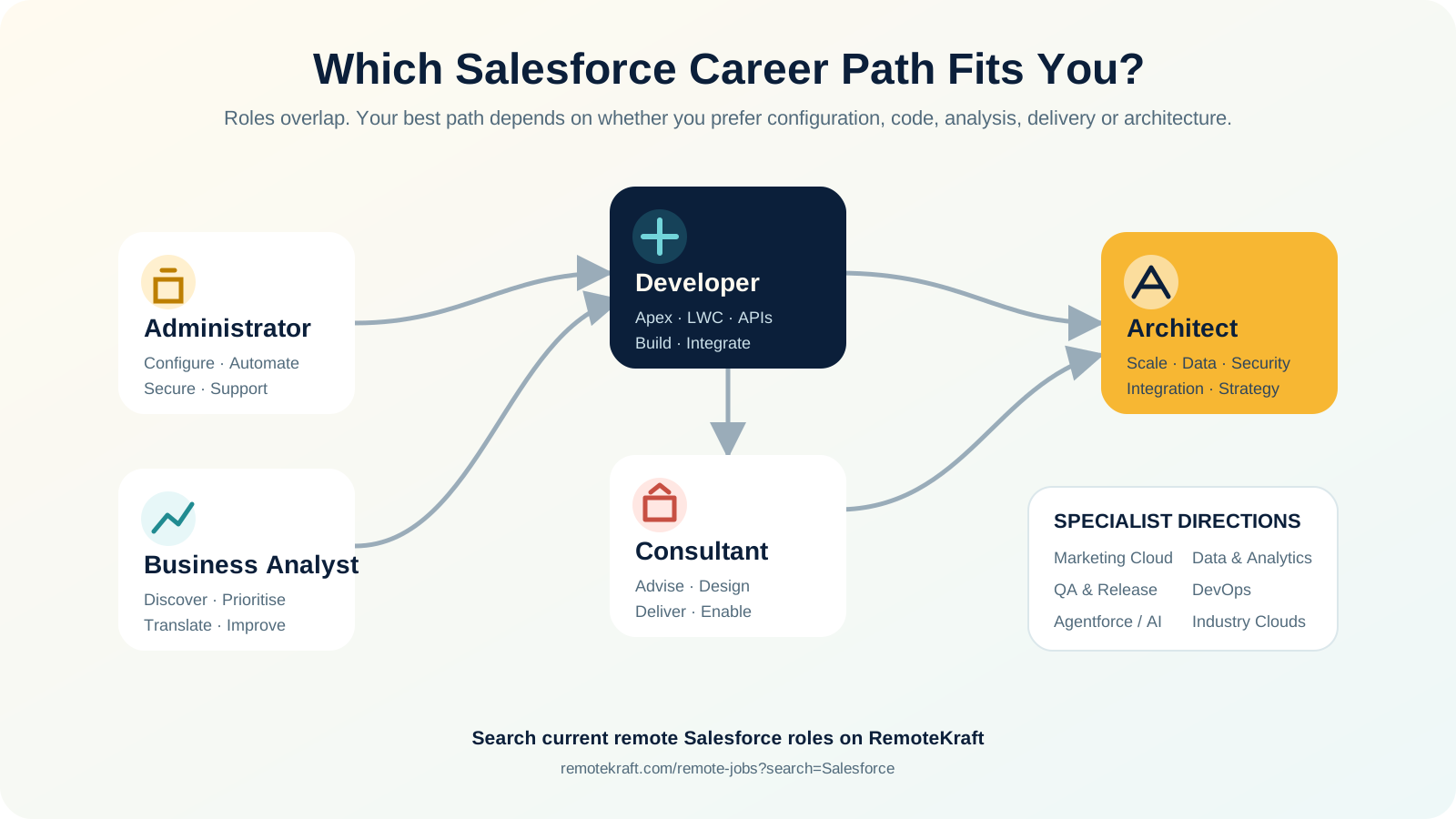
Which Salesforce Role Is Right for You?
- Choose Administrator if you enjoy configuration, automation, data quality, user support and improving day-to-day processes.
- Choose Developer if you enjoy coding, debugging, integrations, performance and building custom platform behaviour.
- Choose Business Analyst if you enjoy discovery, process mapping, requirements, prioritisation and translating between business and technology teams.
- Choose Consultant if you enjoy client conversations, solution design, workshops and guiding implementations from problem to outcome.
- Choose Architect if you have broad delivery experience and enjoy system design, scale, security, data, integration and technical trade-offs.
- Choose a specialist path if you want depth in areas such as Marketing Cloud, CPQ/Revenue Cloud, QA, DevOps, data or AI.
There is no rule that you must remain in one track forever. An Administrator may grow into consulting or architecture; a Developer may move toward technical architecture; a Business Analyst may become a functional consultant or product owner. Build depth in your current role while learning how neighbouring roles make decisions.
Salesforce Skills That Help in Remote Jobs
Platform fundamentals
Understand the Salesforce data model, access model, automation options, reports, environments and release concepts relevant to your role. Developers should know when configuration is enough and when code is justified. Functional professionals should understand the technical consequences of their requirements.
Clear asynchronous communication
Remote Salesforce teams depend on tickets, design notes, pull requests, meeting summaries and handoffs. Write updates that explain the context, decision, status, blocker and next step. Good written communication reduces waiting across time zones.
Security and data awareness
Salesforce often contains sensitive customer and business information. Know the access controls relevant to your work and avoid solving a convenience problem by granting unnecessarily broad permissions. Test with realistic user contexts rather than only as an administrator.
Integration thinking
Even functional roles benefit from understanding where Salesforce data comes from and where it goes next. Learn the basics of APIs, authentication, event-driven integration, error handling and data ownership so you can ask better questions.
Business process understanding
The platform is valuable only when it supports a real workflow. Learn to ask what outcome the team needs, who performs the process, what can go wrong, what must be measured and which controls are required.
Do Salesforce Certifications Help You Get a Remote Job?
Certifications can make your learning path easier to understand and can help recruiters recognise a baseline of platform knowledge, but a certification is not a substitute for practical evidence. Salesforce currently organises credentials across role-oriented tracks such as Administrators, Architects, Consultants, Developers, Business Analysts, Marketers and others.
Choose a certification because it supports the role you are targeting, then pair it with hands-on work. Build a Trailhead project, create a small demo org, document a solution, contribute to a delivery project or write a concise case study. You should be able to explain what you built and why—not only the exam topics you studied.
For current role paths and credential details, check the official Salesforce Trailhead career paths before planning your certification sequence.
How to Make Your Salesforce Resume Stronger for Remote Roles
Use the exact role you are targeting near the top of your resume. A general headline such as “Salesforce Professional” tells a recruiter less than “Salesforce Developer — Apex, LWC, Integrations” or “Salesforce Administrator — Flow, Security, Reports and Data Management.”
In your experience bullets, connect platform work to a business result. Instead of writing “created flows,” explain what process you automated, who used it and what improved. If you worked on an integration, mention the systems involved, your responsibility and how you handled errors, scale or security when relevant.
Remote employers also look for evidence of ownership: documenting solutions, coordinating releases, communicating blockers, reviewing work, supporting users, working across time zones or taking a feature from requirement through production.
If you want a clean starting point, use RemoteKraft's free online resume builder and tailor the finished resume to each Salesforce vacancy.
How to Search Salesforce Jobs on RemoteKraft
A broad Salesforce search is useful for discovery, but role-specific searches usually reduce noise. Start with the title closest to your experience and try nearby variants if the results are too narrow.
- All Salesforce jobs
- Salesforce Developer jobs
- Salesforce Administrator jobs
- Salesforce Architect jobs
- Salesforce Consultant jobs
- Salesforce Business Analyst jobs
- Salesforce Marketing Cloud jobs
- Salesforce QA jobs
Check each listing's location and employment requirements even when the role is labelled remote. A company may hire remotely only in certain countries, states or time zones.
Frequently Asked Questions About Remote Salesforce Jobs
Can freshers get remote Salesforce jobs?
Yes, but entry-level candidates need visible proof that they can work with the platform. A focused Admin or Developer project, Trailhead work, internship, volunteer implementation, testing portfolio or documented case study can help. Apply to roles whose core responsibilities match what you can demonstrate.
Is Salesforce Developer the best Salesforce career?
There is no single best role. Developer is a strong fit for people who enjoy code and technical problem-solving, while Admin, Business Analyst, Consultant, Architect and specialist roles reward different strengths. Choose the path that matches the work you want to do repeatedly.
Do I need coding for every Salesforce job?
No. Administrator and Business Analyst roles can be strongly declarative and process-focused, although technical literacy helps. Developer roles require coding, and Architect or Consultant roles may require different levels of technical depth depending on the project.
Which skills should a Salesforce Developer learn?
Focus on platform fundamentals, Apex, Lightning Web Components, SOQL, testing, security, integrations, asynchronous processing, source control and deployment practices. Learn how Salesforce limits and declarative capabilities affect your design decisions.
Where can I find remote Salesforce jobs?
Use a focused remote-job search and verify the location requirements in each listing. Start with Salesforce Developer jobs on RemoteKraft or browse all Salesforce-related remote jobs.
Start Your Remote Salesforce Job Search
The Salesforce ecosystem offers several career directions, but your search becomes easier when your resume, skills and portfolio point toward one clear role. Choose the work you want to own, build practical evidence, learn the neighbouring skills that make you a stronger teammate, and apply to roles that genuinely match your level and location.




.png)
