



How to Land Remote Embedded Software Engineer Jobs Worldwide: RTOS, Embedded Linux, Firmware Architecture, Remote Hardware Labs, and Global Compensation Blueprint (2026)
Updated November 19, 2026
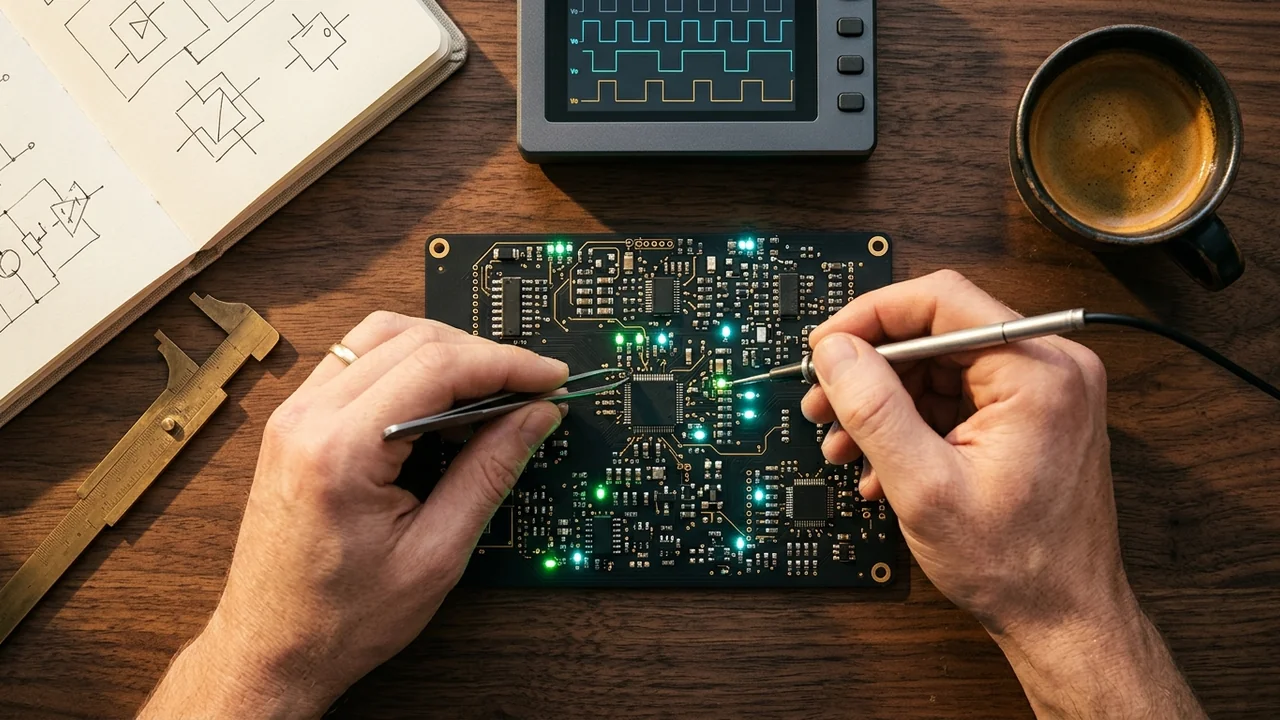
Can embedded software engineers work 100% remotely? In 2026, advances in remote hardware labs, digital logic analyzers with web interfaces, Renode/QEMU emulation, Zephyr RTOS, and cloud-connected HIL test benches have made remote firmware engineering a booming global reality. Discover RemoteKraft's authoritative guide to landing high-paying worldwide remote Embedded Software Engineer roles, covering bare-metal C/C++, Embedded Linux (Yocto), Rust for safety-critical systems, remote bench setups, open-source portfolios, and global USD compensation benchmarks.
For decades, a stubborn industry myth suggested that embedded systems, firmware, and low-level hardware-adjacent engineering could only be conducted inside physical corporate research parks and windowless hardware labs. Conventional wisdom insisted that engineers required direct, physical access to expensive bench oscilloscopes, multi-thousand-dollar spectrum analyzers, custom circuit board prototypes, and thermal chambers to write and validate firmware.
In 2026, that dogma has completely dissolved. A powerful confluence of cloud-managed Hardware-in-the-Loop (HIL) test farms, high-fidelity virtual silicon emulation (such as Renode and QEMU), programmable switched PDUs, USB-over-IP bridging, and compact USB logic analyzers with automated Python APIs (like Saleae Logic 8/Pro 16) has transformed embedded software engineering into a premier remote-first discipline. Global tech innovators in aerospace, autonomous robotics, medical diagnostics, smart grid energy, automotive software-defined vehicles (SDVs), and consumer IoT now routinely coordinate distributed firmware engineering teams spanning the Americas, Europe, Asia, and Africa.
International hardware scale-ups and established enterprise OEMs actively recruit Remote Embedded Software Engineers worldwide. Whether you are developing real-time motor control loops on ARM Cortex-M microcontrollers using Zephyr RTOS from a coastal retreat in Portugal, writing custom Linux device drivers for a RISC-V SoC from your home workbench in Bangalore, or architecting safety-critical medical firmware in embedded Rust from Buenos Aires, borderless hiring unlocks unprecedented flexibility alongside highly lucrative global USD compensation ($90,000 to $185,000+ USD).
Building on RemoteKraft's extensive library of remote technical guides—such as our blueprints for remote distributed systems engineer jobs, remote cybersecurity engineer jobs, remote site reliability engineer jobs, remote backend developer jobs, remote technical interview preparation, and asynchronous time zone management—this comprehensive 2026 playbook provides everything you need to navigate international interviews, configure an elite remote hardware lab, build an irresistible proof-of-work portfolio, and negotiate top-tier worldwide remote contracts.
1. Embedded Software Engineer vs. Firmware Engineer vs. PCB Hardware Designer vs. Systems Programmer
Before launching your international remote job search, it is vital to understand how global hiring committees delineate roles across the hardware-software boundary:
- Remote Embedded Software Engineer: Focuses on the software layer operating directly on microcontrollers (MCUs) and microprocessors (MPUs). Responsible for Real-Time Operating Systems (RTOS), peripheral driver development (SPI, I2C, UART, CAN), board support packages (BSPs), networking stacks (BLE, Wi-Fi, Ethernet, Zigbee), and application-level business logic on resource-constrained devices.
- Firmware Engineer: Often used interchangeably with embedded software engineer, though frequently emphasizing lower-level, non-volatile initialization code: bootloaders (U-Boot, Coreboot), power-on self-test (POST) routines, BIOS/UEFI implementations, memory controllers, and direct register manipulation before the primary OS or application environment boots.
- Hardware / PCB Design Engineer: Focuses on physical schematic capture, component selection, high-speed printed circuit board (PCB) routing, signal integrity, electromagnetic compatibility (EMC/EMI), power delivery networks, and physical fabrication files (Gerbers). While PCB designers also work remotely, their core deliverables are hardware schematics rather than firmware binaries.
- Systems Software Programmer: Operates at the intersection of operating systems and application runtimes—building hypervisors, compilers, container runtimes, or database storage engines in C++, Go, or Rust on standard x86/ARM servers. Compare skills in our guide to remote software engineering jobs.
2. The Modern Remote Embedded Tech Stack for 2026
To win competitive worldwide remote offers, candidates must demonstrate commanding expertise across four primary technical pillars:
A. Bare-Metal Architecture & Real-Time Operating Systems (RTOS)
At the microcontroller level (ARM Cortex-M0/M3/M4/M7, RISC-V, ESP32, STM32), international engineering teams seek mastery over low-latency, deterministic execution:
- Bare-Metal Programming: Writing direct register manipulation code without an operating system, configuring memory-mapped I/O, clock trees, nested vectored interrupt controllers (NVIC), direct memory access (DMA) controllers, and linker scripts (custom memory layouts across Flash, SRAM, and CCM).
- Zephyr RTOS: The undisputed industry-standard modern open-source RTOS for connected edge devices. Employers seek engineers proficient with Zephyr's device tree syntax, Kconfig configuration, multi-threading kernel primitives (semaphores, mutexes, message queues, workqueues), low-power management subsystems, and native Bluetooth Low Energy (BLE) controller stacks.
- FreeRTOS & ThreadX: Designing preemptive and cooperative scheduling models, calculating task stack allocations, preventing priority inversion using priority inheritance mutexes, and integrating FreeRTOS with TCP/IP (lwIP) and TLS security libraries (Mbed TLS).
- Ultra-Low-Power Optimization: Designing firmware for battery-operated devices expected to last 5 to 10 years in the field. Implementing aggressive tickless idle modes, dynamic frequency scaling, sensor sleep duty cycles, and deep sleep wakeup triggers.
B. Embedded Linux & Board Support Package (BSP) Development
For compute-heavy edge devices (gateways, robotics, computer vision, smart displays) running ARM Cortex-A or RISC-V processors, Embedded Linux is dominant:
- Linux Kernel & Device Drivers: Authoring and debugging kernel modules, character devices, platform drivers, and interrupt handlers. Fluency in Linux device tree source (DTS) authoring to map physical hardware pinmuxing and peripheral buses to kernel subsystems.
- Yocto Project & OpenEmbedded: Creating custom BSP layers, machine definitions, BitBake recipes, package groups, and minimal root filesystem distributions tailored strictly to target hardware requirements.
- Buildroot: Generating lean, fast-booting Embedded Linux appliances for embedded systems where full Yocto overhead is unnecessary.
- Secure Boot & Over-the-Air (OTA) Updates: Implementing cryptographic chain-of-trust from hardware root-of-trust (e.g., TPM 2.0, ARM TrustZone) through U-Boot verified boot (FIT images), dm-verity read-only rootfilesystems, and dual-bank (A/B) resilient OTA upgrade systems using frameworks like RAUC or Mender.
C. Modern Safety-Critical Systems & Embedded Rust
In 2026, the embedded industry is experiencing a generational shift toward memory-safe languages for safety-critical and network-facing firmware:
- Embedded Rust (
no_std): Developing bare-metal and RTOS applications utilizing Rust's strict ownership model, preventing buffer overflows, use-after-free errors, and data races at compile time. Utilizing crates from the Rust Embedded Working Group, such asembedded-hal,embassy(async embedded runtime), and PAC/HAL libraries. - Modern Modernized C & C++ (C11/C17, C++20): Adhering to strict safety standards such as MISRA C:2023 and SEI CERT C. Leveraging modern C++ concepts, RAII, constexpr compile-time calculations, and fixed-size static allocations while avoiding dynamic heap allocations (preventing heap fragmentation).
- Functional Safety Standards: Understanding compliance frameworks required by enterprise employers, including ISO 26262 (automotive ASIL levels), IEC 62304 (medical device software), and IEC 61508 (industrial automation).
D. Industrial & Wireless Communication Protocols
Remote edge products thrive on robust, fault-tolerant communication pipelines:
- Hardware Busses: Deep debugging knowledge of I2C (clock stretching, pull-up sizing, bus arbitration), SPI (clock polarity/phase modes CPOL/CPHA, multi-slave chip-select routing), UART/RS-485, and CAN/CAN-FD bus architectures with differential signaling and frame arbitration.
- Wireless Connectivity: Designing reliable firmware for Bluetooth 5.x / BLE Mesh, Wi-Fi 6, Zigbee / Thread (Matter standard), LoRaWAN for long-range telemetry, and Cellular IoT (LTE-M, NB-IoT).
- Edge-to-Cloud Telemetry: Formatting payloads using Protocol Buffers (protobuf) or CBOR, communicating over lightweight MQTT / CoAP protocols with TLS 1.3 encryption to AWS IoT Core, Azure IoT Hub, or private cloud ingest brokers.
3. Setting Up an Elite Remote Hardware Engineering Lab at Home
The secret to succeeding as a remote embedded engineer lies in building a modular, automated workbench that eliminates friction between software iteration and physical hardware:
The Remote Embedded Engineer's Essential Hardware Toolkit:
- Automated Logic Analyzer: A USB-based logic analyzer (such as a Saleae Logic 8 or Pro 16) capable of capturing digital bus traffic (I2C, SPI, UART, CAN) and scriptable via the Saleae Python automation API.
- Smart Switched PDU / Relays: Wi-Fi or USB-controlled smart power strips (or relay breakout boards) allowing you to programmatically power-cycle frozen development boards during automated overnight testing.
- Remote JTAG/SWD Debug Probes: High-speed hardware debuggers like the SEGGER J-Link (running J-Link Remote Server) or open-source Black Magic Probe, enabling firmware flashing, hardware breakpoints, and real-time terminal logging (RTT) over local or VPN networks.
- USB-over-IP & Webcams: Tools like
usbipto attach physical target devices connected to a home server directly to remote VMs, coupled with an overhead high-definition webcam trained on board status LEDs and seven-segment displays. - Compact Digital Multimeter & Adjustable DC Bench Power Supply: Programmable bench supplies (with SCPI interface over USB) that allow setting overcurrent protection and logging current consumption during low-power sleep profiling.
Leveraging Virtual Silicon: Renode & QEMU for Headless CI/CD
Leading remote-first engineering organizations do not wait for physical hardware boards to arrive in the mail to test firmware pull requests. They incorporate automated virtual hardware simulation into their GitHub Actions and GitLab CI/CD pipelines:
- Renode (by Antmicro): An open-source virtual development framework that models complete multi-node embedded systems—including CPUs, peripheral registers, sensors, transceivers, and wireless medium simulation. Firmware binaries compiled for physical STM32, Nordic nRF52/nRF53, or RISC-V targets run unmodified in Renode inside headless Linux CI runners, validating GPIO triggers, UART telemetry, and communication protocols automatically on every git push.
- QEMU System Emulation: Emulating full ARMv7/AArch64 platforms to boot custom Yocto Linux kernels and user-space binaries before physical silicon tape-out or prototype delivery.
4. How International Companies Evaluate Remote Embedded Candidates
Landing a high-paying remote offer requires clearing a multi-stage technical evaluation designed to assess self-sufficiency, asynchronous problem solving, and low-level diagnostic skills:
- Asynchronous Technical Screener: Reviewing your open-source code repositories, personal hardware blog posts, or answering foundational diagnostic questions (e.g., explaining volatile keyword semantics in C, interrupt latency factors, or diagnosing an unexpected HardFault exception).
- Live Low-Level Coding & Data Structures: Implementing core embedded data structures in pure C or Rust: lock-free circular ring buffers (FIFO) for UART streaming, bitwise manipulation algorithms, fixed-point math routines, or finite state machine (FSM) parsers. Practice your fundamentals using our technical interview preparation framework.
- System Architecture & Firmware Design Interview: Designing an end-to-end connected device architecture on a digital canvas. For example: "Architect a battery-powered industrial vibration sensor that samples an SPI accelerometer at 1 kHz, computes an FFT, sends alerts via LoRaWAN, sleeps in micro-amp standby, and supports fail-safe dual-bank OTA updates." Interviewers evaluate component selection, power budgets, RTOS task partitioning, and failure recovery.
- Hands-On Practical Lab or Remote Debugging Exercise: Many forward-thinking companies ship a small development kit (e.g., Nordic nRF52840-DK or Raspberry Pi Pico) directly to your home address, or grant access to a cloud-connected test bench over SSH, asking you to diagnose a simulated peripheral driver bug, resolve an I2C bus lockup, or implement a multi-threaded BLE sensor reader within 48 hours.
5. Three Portfolio Projects That Win Worldwide Remote Embedded Roles
When applying across borders, a resume listing generic job titles is easily overlooked. What commands instant credibility with international hiring directors is a public GitHub portfolio demonstrating real-world hardware software craftsmanship:
Project 1: Connected Low-Power Sensor Gateway on Zephyr RTOS
Build an end-to-end battery-optimized sensor node based on an nRF52840 or STM32WB microcontroller:
- Integrate an environmental sensor (BME680 or SHT40) over I2C with dynamic error recovery and bus re-initialization.
- Utilize Zephyr RTOS threads, power management subsystems (entering System OFF mode between samples), and BLE custom GATT services to stream sensor data to a mobile device.
- Include automated CI testing using Renode in GitHub Actions that flashes the compiled ELF binary, simulates sensor stimulus, and asserts expected BLE advertisement packets.
Project 2: Custom Yocto Linux BSP with Character Device Driver
Demonstrate mastery over high-end embedded Linux for industrial computing:
- Create a dedicated Yocto meta-layer targeting a popular SBC (BeagleBone Black, Raspberry Pi Compute Module 4, or generic ARM QEMU target).
- Write a custom out-of-tree Linux kernel character device driver that interacts with virtual hardware registers, handles interrupt requests (IRQs), and exposes sysfs control nodes.
- Package a minimal root filesystem featuring an automated systemd daemon in modern C++ or Rust that consumes the device driver and streams telemetry via MQTT.
Project 3: Memory-Safe Embedded Rust Peripheral Driver with embedded-hal
Highlight cutting-edge safety and modern developer workflows:
- Develop a complete, published
no_stdRust driver for an SPI display controller or cryptographic secure element using theembedded-halabstractions. - Provide 100% test coverage using mock drivers for host-side unit testing, automated documentation hosted on docs.rs, and sample firmware running on both QEMU and physical hardware.
6. Global Remote Compensation Benchmarks & Employment Models (2026)
Embedded software engineering talent is in acute shortage worldwide, particularly for engineers proficient in modern RTOS, Linux BSPs, and embedded Rust. International companies structure compensation based on global market value rather than domestic local rates:
| Experience Level | Key Responsibilities | Annual Base (USD) | Common Perks |
|---|---|---|---|
| Junior / Mid Embedded Engineer (2–4 yrs) | Peripheral driver implementation, board bring-up, RTOS task creation, automated unit tests, bug fixes. | $70,000 – $110,000 | Hardware lab stipend ($2,500), home office setup, tech equipment shipment. |
| Senior Embedded Software Engineer (5–8 yrs) | Firmware architecture, Yocto BSP maintenance, custom kernel drivers, power profiling, HIL CI/CD pipeline design. | $120,000 – $175,000 | Equity options, comprehensive health insurance, annual home lab refresh budget. |
| Staff / Principal Firmware Architect (9+ yrs) | Cross-product architecture, silicon vendor evaluation, security certification (PSA Certified), functional safety leadership. | $175,000 – $235,000+ | High-tier equity/RSUs, performance bonuses, international lab conference travel. |
International remote engagements are typically formalized through two compliant pathways: Employer of Record (EOR) arrangements (via global platforms like Deel or Remote, providing local statutory benefits and payroll in your domestic currency) or direct Independent International Contractor agreements (billed in USD with favorable tax structures for tech consultancies). For an in-depth breakdown of legal protections and tax implications, read our guide on remote employee versus contractor models.
7. Frequently Asked Questions (FAQs)
Can embedded software engineers really work 100% remotely without touching company hardware in person?
Yes. Tens of thousands of embedded engineers work full-time remotely across the world. International hardware companies ship development kits, custom pre-production boards, and breakout tools directly to your home via international couriers (DHL, FedEx). Furthermore, companies maintain centralized hardware rack farms in corporate offices where engineers connect remotely over SSH, VPN, and USB-over-IP to flash and test code on physical hardware clusters.
How do remote embedded engineers receive physical hardware prototypes from overseas employers?
Standard operating procedure involves employers shipping "Lab-in-a-Box" kits during onboarding. These kits contain reference evaluation boards (Nordic, STMicroelectronics, NXP, TI), USB logic analyzers, serial debuggers, and power monitors. When proprietary revision boards are manufactured, companies cover all international shipping, customs declarations, and import duties directly through corporate logistics partners.
Is Rust replacing C and C++ in embedded systems in 2026?
Rust is not eliminating C and C++, but it is rapidly gaining substantial market share for new safety-critical, network-connected, and defense projects. Major tech companies and automotive consortiums actively encourage Rust for security-sensitive edge applications to eliminate memory vulnerabilities. Candidates who combine deep C/C++ legacy firmware knowledge with modern embedded Rust fluency possess a tremendous competitive edge in international hiring.
What certifications or credentials carry the most weight for remote embedded roles?
In the embedded domain, demonstrated proof-of-work on public GitHub repositories consistently outperforms paper certifications. However, specialized credentials such as The Linux Foundation's Embedded Linux Development with Yocto Project (LFD460), Zephyr Project Community Badges, and verified contributions to major open-source firmware projects (Zephyr, Linux Kernel, FreeRTOS, Rust Embedded) provide immense validation to technical recruiters.
How can engineers from India, Latin America, and Southeast Asia land US-dollar remote firmware positions?
Worldwide companies evaluate low-level engineers strictly on their technical craftsmanship, asynchronous communication clarity, and problem-solving rigor. By publishing well-documented open-source firmware libraries, creating video demonstrations of working hardware setups, practicing concise architectural communication, and utilizing curated global platforms like RemoteKraft's verified remote jobs, engineers across emerging tech markets routinely secure high-paying international contracts. Ensure your CV emphasizes asynchronous autonomy using our skills-first remote resume guide.
Ready to build the real-time firmware, IoT platforms, and low-level Linux systems powering the next generation of global hardware from anywhere in the world? Explore verified worldwide openings on RemoteKraft's remote job board, build an ATS-optimized technical resume using our free online resume builder, and launch your high-impact worldwide remote embedded engineering career today.




.png)
