


Your next remote interview may not begin with a person. It could start with a recorded video prompt, a voice bot, a timed text conversation, or a skills assessment that uses automated checks. That does not mean you need to guess what an algorithm wants. Good AI job interview preparation still rests on the same foundation as a strong human interview: understand the role, use relevant evidence, communicate clearly, and represent your work honestly.
The format is becoming more visible in 2026. An Associated Press guide published in June 2026 explains that AI interviews can happen through video, phone, or text and are often used for early screening. At the same time, employers are paying closer attention to authenticity. The Economic Times reported in June 2026 that Indian companies are using deeper, scenario-based follow-ups to distinguish genuine thinking from hidden AI assistance.
This guide helps candidates in India prepare for that reality without scripts, shortcuts, or claims they cannot defend.
What Is an AI Job Interview?
“AI interview” is an umbrella term. The invitation should tell you what will happen, but the most common formats include:
- One-way recorded video: A question appears on screen, you receive preparation time, and you record an answer within a limit.
- Automated voice interview: A voice agent asks questions and may choose follow-ups based on your response.
- Text-based screening: A chatbot collects information about your experience, availability, skills, or work preferences.
- Live video with automated support: A human interviewer leads the call while software transcribes, schedules, verifies identity, or helps organise notes.
- AI-assisted assessment: You complete a work sample, case, coding task, or simulation where the employer defines whether AI tools are allowed.
These formats are not interchangeable. A recorded interview tests concise delivery under a timer. A live interview tests interaction and follow-up reasoning. A work sample tests how you perform a task. Read the instructions instead of assuming that every automated step evaluates the same signals.
Before You Prepare, Verify the Invitation
Remote hiring can make a fake process look convincing because the candidate never visits an office. Verify the employer before sharing documents or recording personal information.
- Compare the sender's domain with the company's official website.
- Confirm that you applied for the role or can trace the recruiter through an official channel.
- Check the interview platform link and privacy notice before granting camera or microphone access.
- Do not pay an interview, training, software, or equipment fee.
- Do not share banking credentials, passwords, one-time codes, or unnecessary identity documents during screening.
If something feels inconsistent, pause and verify independently. Our guide to genuine remote jobs in India covers company checks and common warning signs in more detail.
A Seven-Step AI Interview Preparation Plan
1. Decode the job description
Create three short lists: the outcomes the role owns, the skills it requires, and the remote-work behaviours it implies. For example, “manage customer escalations” is an outcome; written communication is a skill; and documenting handovers across time zones is a remote-work behaviour.
Choose four or five requirements you can support with real evidence. You do not need a story for every line of the advertisement. You do need detailed examples for the responsibilities that appear central to the role.
2. Build an evidence bank, not a script
Prepare six compact examples from work, study, internships, volunteering, freelance projects, or serious personal projects. Cover a mix of situations:
- a difficult problem you solved;
- a mistake or weak result you corrected;
- a time you worked independently;
- a disagreement or unclear requirement you resolved;
- a task you prioritised under a deadline; and
- a result you communicated in writing.
For each example, write only four prompts: situation, responsibility, actions, and result. This is the familiar STAR structure, but your notes should be memory cues rather than sentences to recite.
3. Practise answers at different lengths
A one-way platform may allow only a short response, while a human interviewer may ask several follow-ups. Practise the same example in 45 seconds, 90 seconds, and two minutes.
Start with the answer, then explain the evidence. Instead of spending a minute on background, say: “I reduced missed handovers by creating one shared checklist and an end-of-day update. Here is what was going wrong and how I changed it.” This makes the response easier to follow without sounding rehearsed.
4. Prepare for remote-work questions
Remote employers need confidence that you can make progress without constant supervision. Prepare examples that show:
- how you clarify an unclear task;
- how you update people before a deadline becomes a problem;
- how you document decisions;
- how you collaborate across different schedules; and
- how you protect customer or company information at home.
Avoid saying only that you are self-motivated. Describe the system you use: priorities, check-ins, written updates, escalation points, and proof that it worked.
5. Decide your AI boundaries before the interview
AI can be useful during preparation. You might ask it to generate practice questions from a job description, identify gaps in a draft answer, or simulate follow-up questions. Remove private data and verify its feedback yourself.
During the actual interview, follow the employer's stated rules. Do not run a hidden answer generator, read responses from another screen, use a proxy candidate, or disguise someone else's work as your own. Even an impressive answer weakens quickly if you cannot explain the reasoning behind it.
When the instructions are silent, ask: “Are any AI tools permitted during this assessment, and if so, how should I disclose their use?” A clear question is safer than inventing your own rule.
6. Test the technical setup for Indian conditions
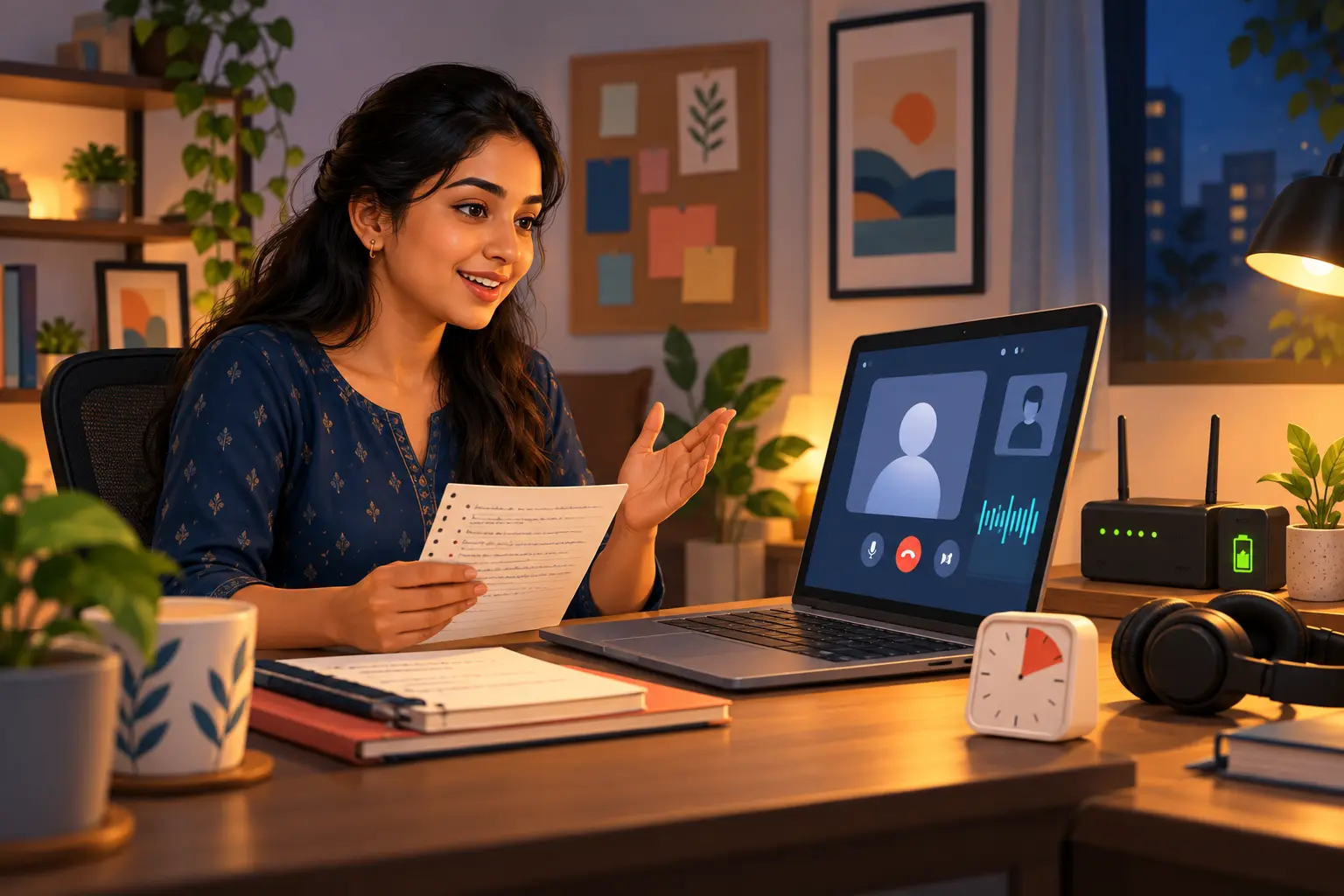
Complete a full rehearsal on the same device, connection, browser, and location you plan to use. Your checklist should include:
- a charged laptop and working charger;
- camera at eye level with your face evenly lit;
- clear microphone audio without a loud fan or echo;
- updated browser permissions for the approved platform;
- a stable main connection and a tested mobile-data backup;
- power backup where outages are a realistic risk;
- notifications and unrelated applications closed; and
- the recruiter's contact details available outside the interview window.
If the platform offers a practice question, use it. Confirm that the recording contains both audio and video. A speed test alone will not reveal a blocked microphone permission or an aggressive browser extension.
7. Plan for a failure without panicking
Write a short message in advance: “I joined at the scheduled time, but the interview platform stopped after the second question. I have saved the error message and would appreciate a retry link or the next available step.”
If a genuine failure happens, capture the time and error, retry once if the instructions allow it, and contact the recruiter promptly. Do not repeatedly refresh a recorded interview if the platform warns that doing so will submit or end the attempt.
How to Handle a One-Way Video Interview
The absence of a human reaction can feel unnatural. Focus on structure rather than trying to imagine what the system thinks.
- Read the entire question. Identify whether it asks for an example, an opinion, a process, or a technical explanation.
- Use preparation time deliberately. Note three words: your main point, the example, and the result.
- Look near the camera. You do not need rigid eye contact, but avoid reading continuously from another screen.
- Pause naturally. A brief pause is better than filling every second with repeated phrases.
- End clearly. State what changed, what you learned, or how the example relates to the role.
If re-recording is allowed, set a limit for yourself. Repeating an answer many times often makes it less natural. Re-record only when there is a real technical problem or you missed an essential part of the question.
How to Respond When a Live Interviewer Suspects AI Use
In 2026, some interviewers are deliberately asking deeper questions because polished, generic answers are easy to generate. A LinkedIn analysis published in September 2025 described renewed interest in live or in-person interviews as companies respond to AI-assisted candidate fraud and seek stronger evidence of real skills.
The best response is not to perform spontaneity. Make your reasoning visible:
- name the constraint you considered first;
- explain the alternative you rejected and why;
- separate what you personally did from the team's contribution;
- admit what you did not know at the start; and
- answer follow-ups with the same facts rather than changing the story.
If you used AI legitimately in the project being discussed, say how. For example: “I used an approved assistant to draft test cases, reviewed them against the acceptance criteria, removed irrelevant cases, and added boundary conditions it missed.” That demonstrates judgement instead of pretending the tool did not exist.
Five Practice Questions for Remote Roles
How do you make progress when your manager is offline?
Explain how you confirm priorities, use written requirements, record assumptions, complete reversible work, and flag blockers. Give one real example.
Tell us about a misunderstanding caused by written communication
Show that you can identify the gap, correct it respectfully, and improve the process. Avoid blaming the other person.
How do you manage work across time zones?
Discuss planned overlap, handover notes, response expectations, and what genuinely requires a live meeting. Do not promise to be available at every hour.
Describe a decision you made with incomplete information
State the risk, the information available, the safe next step, and how you checked the outcome. This reveals judgement more clearly than a perfect final result.
How have you used AI in your work?
Choose one bounded workflow. Explain the input, safeguards, review process, errors you caught, and final value. Our guide to AI skills for remote jobs in India includes proof-of-work examples you can adapt honestly.
After the Interview
Save the job description, the questions you remember, your examples, and any technical issue. Note where an answer became vague or too long. Improve the underlying example before the next interview instead of memorising a more polished script.
For a human-led interview, a short thank-you message can confirm interest and one relevant point from the discussion. For an automated screening, follow the platform's stated process and avoid sending repeated messages when a response timeline is already provided.
Frequently Asked Questions
Can an AI interviewer reject me automatically?
Processes differ by employer and platform. Automated tools may collect, transcribe, score, or organise information, while people may make later decisions. Ask the recruiter how the stage is reviewed if the invitation does not explain it.
Should I disclose that I used AI to practise?
Normal preparation does not usually require a disclosure. During an assessment or interview, follow the stated rules. If AI is allowed for a work sample, document how you used it and what you verified.
What should I wear for a remote video interview?
Choose clean, comfortable clothing slightly more polished than the employer's everyday style. Avoid patterns that flicker on camera, test the framing, and make sure your clothing remains appropriate when you sit and move.
What if I need an accessibility adjustment?
Contact the recruiter as early as practical, describe the adjustment needed for the interview format, and ask for an accessible alternative when necessary. You do not need to provide unrelated medical detail.
Can freshers prepare without professional examples?
Yes. Use evidence from college projects, internships, volunteering, competitions, family responsibilities, or independent work. Focus on your actions and learning. You can also use our guide to remote jobs for freshers in India.
Prepare to Explain Your Thinking
AI-assisted hiring may change the interface, but candidates still stand out through relevant evidence, clear reasoning, and trust. Prepare examples you own, test your setup, follow the employer's tool rules, and practise explaining how you reached a decision.
When you are ready to apply, refine your resume with the RemoteKraft resume builder and explore remote jobs for candidates in India. Save this checklist so the interview format does not distract you from the work you can genuinely do.




.png)
